


The Interconnection Between Essential Nutrient Deficiencies – Compromised Liver Health- Insulin Resistance and Type II Diabetes
Insulin resistance and compromised liver health are critical health concerns with significant implications for human health. Both conditions are often interlinked and exacerbated by essential nutrient deficiencies.
Insulin resistance is a pathological condition where the body’s cells become less responsive to the hormone insulin. At first the pancreas compensates by releasing more insulin; blood glucose rises once it can no longer keep up. This condition is a major precursor to type 2 diabetes mellitus (T2DM) and is associated with various metabolic disorders.
- Mechanism: Insulin binds to receptors on cell surfaces to facilitate glucose uptake. In insulin resistance, this signaling pathway is impaired.
- Consequences: Persistent hyperglycemia, increased risk of cardiovascular diseases, and progression to T2DM.
Compromised Liver Health and Nutrient Deficiencies
The liver plays a vital role in metabolism, detoxification, and nutrient storage. A lack of choline, an essential nutrient, is known to cause fatty liver in humans. Inositol and taurine are also made by the body itself, and methionine is an essential amino acid; all four take part in liver metabolism.
- Choline: Essential for liver function, choline is needed to package fat into VLDL and export it from the liver; without enough choline, fat builds up in the liver.
- Inositol: Plays a role in fat metabolism and insulin signaling. In animal studies, inositol supplementation reduced liver fat; human evidence is still limited to small trials.
- Taurine: An amino acid that aids in bile salt formation, detoxification, and protection against oxidative stress.
- Methionine: A vital amino acid for methylation reactions and the synthesis of S-adenosylmethionine (SAMe), crucial for liver function and repair.
Insulin Resistance Closed Loop
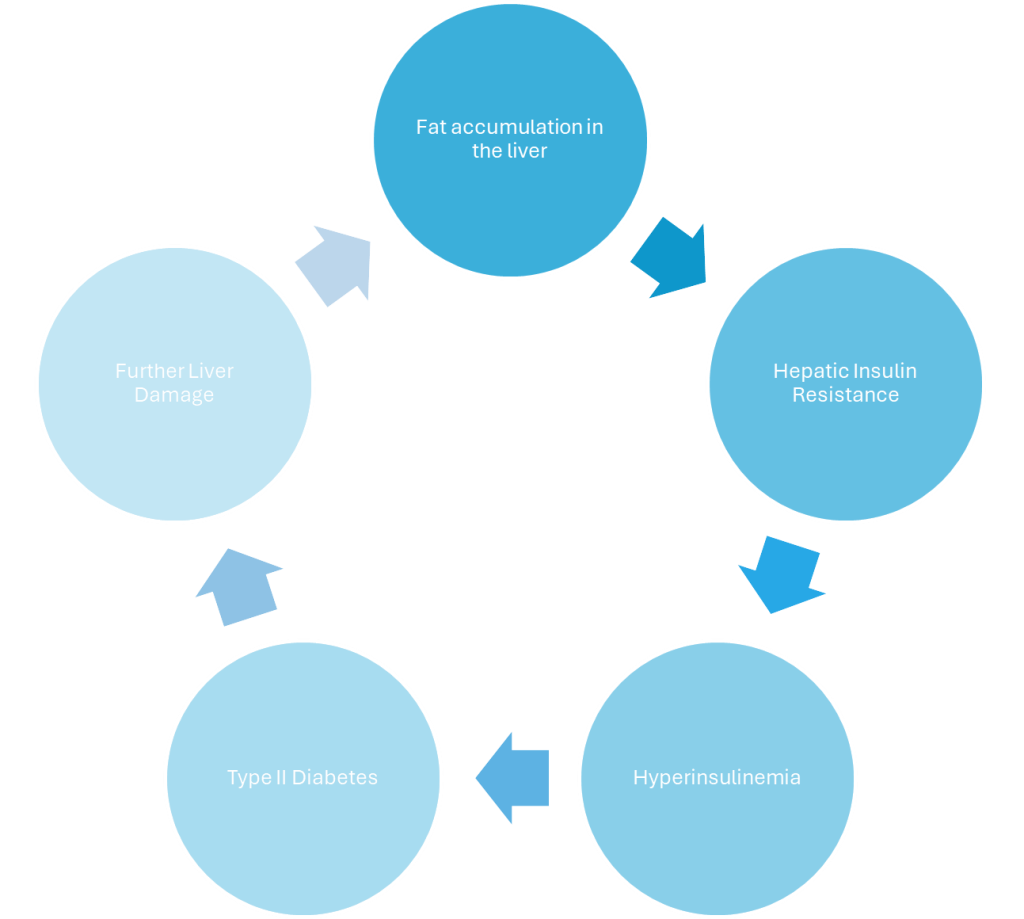
The relationship between nutrient deficiencies- fat accumulation in the liver- insulin resistance and Type II Diabetes forms a closed loop, where each condition exacerbates the others.
- Essential Nutrient Deficiency: A lack of choline impairs fat export from the liver and can lead to fat accumulation. Most metabolic dysfunction-associated steatotic liver disease (MASLD, formerly NAFLD), however, is driven by excess energy intake and insulin resistance.
- NAFLD: The accumulation of fat in the liver results in hepatic insulin resistance, disrupting glucose homeostasis.
- Insulin Resistance: Peripheral insulin resistance exacerbates hyperglycemia, leading to compensatory hyperinsulinemia and further fat accumulation in the liver.
- Type II Diabetes: Chronic insulin resistance can progress to Type II Diabetes, perpetuating a cycle of metabolic dysfunction and liver damage.
Implications on Human Health
The synergistic effects of insulin resistance, compromised liver health, and essential nutrient deficiencies have far-reaching implications on overall health like:
- Metabolic Syndrome: A cluster of conditions including insulin resistance, hypertension, dyslipidemia, and central obesity, increasing the risk of cardiovascular diseases.
- Cardiovascular Health: Elevated risk of atherosclerosis, coronary artery disease, and stroke due to persistent hyperglycemia and dyslipidemia.
- Liver Complications: Progression from NAFLD to non-alcoholic steatohepatitis (NASH), cirrhosis, and hepatocellular carcinoma.
- Systemic Inflammation: Chronic low-grade inflammation, linked with a range of chronic disorders, including cardiovascular disease.
What reduces liver fat most reliably is weight loss, regular movement and less sugar and refined carbohydrate. Of the four nutrients above, choline is the one with EU-approved health claims: it contributes to normal lipid metabolism and to the maintenance of normal liver function. If you would like to see how we paired it with myo-inositol, methionine and taurine in LiverGuard, and at what doses, it is all laid out on the product page.
How Insulin Resistance Is Measured
Insulin resistance is rarely diagnosed from a single number. The commonly used markers are fasting glucose, fasting insulin, and the HOMA-IR index calculated from the two; HbA1c, which reflects average glycaemia over roughly three months; and an oral glucose tolerance test where the picture is unclear. The triglyceride-to-HDL ratio and waist circumference are useful, inexpensive proxies that often move before fasting glucose does.
This matters because fasting glucose is typically the last marker to drift. Compensatory hyperinsulinaemia can hold glucose in the normal range for years while insulin sensitivity is already declining, which is why a normal glucose result on its own does not rule the problem out.
Why Liver Fat and Insulin Resistance Reinforce Each Other
The relationship runs in both directions, which is what makes it self-sustaining. Excess carbohydrate and energy intake drive de novo lipogenesis in the liver, converting substrate into fatty acids. Visceral fat delivers free fatty acids straight to the liver through the portal vein, adding to the load. Accumulating lipid intermediates – particularly diacylglycerol, which activates PKC-epsilon – interfere with insulin receptor signalling in the hepatocyte.
The result is selective hepatic insulin resistance, an odd and important asymmetry: the liver stops responding to insulin’s instruction to suppress glucose output, while remaining responsive to its instruction to build fat. So the liver keeps releasing glucose and keeps making fat at the same time. Blood glucose rises, insulin rises to compensate, and lipogenesis is pushed harder still. This is the loop, and it is why interventions that reduce liver fat, such as weight loss, tend to improve glycaemic markers as well.
References
- DeFronzo, R. A., Ferrannini, E., Zimmet, P., & Alberti, G. (Eds.). (2015). International Textbook of Diabetes Mellitus (4th ed.). Wiley-Blackwell. DOI: 10.1002/9781118387658
- Targher, G., Corey, K. E., Byrne, C. D., & Roden, M. (2021). The complex link between NAFLD and type 2 diabetes mellitus — mechanisms and treatments. Nature Reviews Gastroenterology & Hepatology, 18(9), 599-612. DOI: 10.1038/s41575-021-00448-y
- Pickett-Blakely, O., Young, K., & Carr, R. M. (2018). Micronutrients in Nonalcoholic Fatty Liver Disease Pathogenesis. Cellular and Molecular Gastroenterology and Hepatology, 6(4), 451-462. DOI: 10.1016/j.jcmgh.2018.07.004
- Day, C. P. (2006). From fat to inflammation. Gastroenterology, 130(1), 207-210. DOI: 10.1053/j.gastro.2005.11.017
- Zeisel, S. H., & da Costa, K. A. (2009). Choline: an essential nutrient for public health. Nutrition Reviews, 67(11), 615-623. DOI: 10.1111/j.1753-4887.2009.00246.x
- Pani, A., Giossi, R., Menichelli, D., et al. (2020). Inositol and Non-Alcoholic Fatty Liver Disease: A Systematic Review on Deficiencies and Supplementation. Nutrients, 12(11), 3379. DOI: 10.3390/nu12113379
- Hayes, K. C., & Sturman, J. A. (1981). Taurine in metabolism. Annual Review of Nutrition, 1, 401-425. DOI: 10.1146/annurev.nu.01.070181.002153
- Finkelstein, J. D. (1990). Methionine metabolism in mammals. The Journal of Nutritional Biochemistry, 1(5), 228-237. DOI: 10.1016/0955-2863(90)90070-2